As we navigate 2026, the American Cancer Society has released its annual “Cancer Facts & Figures” report, providing a comprehensive look at the current state of oncology in the United States. At United Diagnostic Services, we believe that understanding these data points is the first step toward better health outcomes. This guide simplifies the complex statistics of the 2026 report to help you stay informed about the latest trends in diagnosis, survival, and prevention.
You can access the full American Cancer Society 2026 report here.
2026 Vital Statistics: The National Burden
This year, the United States is projected to see approximately 2,114,850 new invasive cancer cases. This figure excludes most non-melanoma skin cancers and in situ carcinomas, with the exception of urinary bladder cancer.
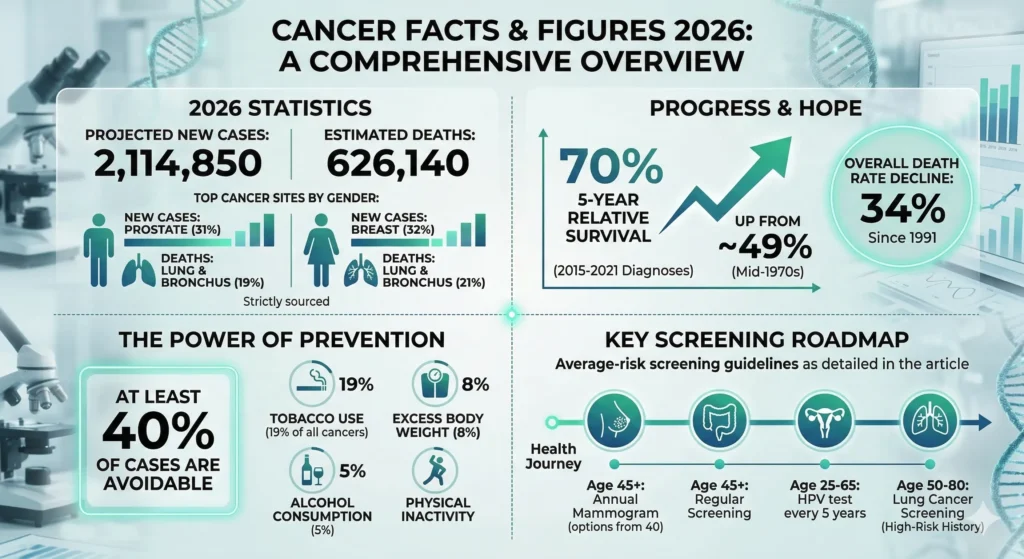
The report also estimates that 626,140 individuals will die from cancer in 2026, which averages to about 1,700 deaths every single day.
Leading Sites of New Cases and Deaths
The impact of cancer varies significantly by biological sex. According to the 2026 projections, the following are the most common sites for new diagnoses and cancer-related deaths:
| Category | Top Site for Males | Top Site for Females |
| New Cancer Cases | Prostate (31%) | Breast (32%) |
| Cancer Deaths | Lung & Bronchus (19%) | Lung & Bronchus (21%) |
The Survival Milestone: 70% and Rising
One of the most significant achievements noted in the 2026 report is the continued improvement in survival rates. The 5-year relative survival rate for all cancers combined has reached 70% for those diagnosed between 2015 and 2021. This is a major increase from the mid-1970s, when the survival rate was approximately 49%.
Important Definitions for Patients
To understand these milestones, it is helpful to define the terms used by researchers:
- Relative Survival: A measure comparing the life expectancy of people with cancer to the general population of the same age, race, and sex.
- In Situ: Cancer that remains confined to the original layer of cells where it first began.
- Invasive: Cancer cells that have penetrated beyond the original layer into surrounding tissue.
- Staging: A system describing the extent of cancer growth, often categorized as local, regional, or distant spread.
The overall cancer death rate has dropped 34% from its peak in 1991 through 2023. This progress reflects a combination of reduced smoking rates, advances in medical treatment, and the effectiveness of early detection through screening.
The Power of Prevention: 40% of Cases are Avoidable
Perhaps the most empowering finding in the 2026 report is that at least 40% of newly diagnosed cancers in US adults (roughly 850,000 cases this year) are potentially avoidable. These cases are linked to modifiable risk factors that individuals can influence through lifestyle choices.
Key Modifiable Risk Factors
- Tobacco Use: Smoking remains the most preventable cause of cancer, accounting for 19% of all new cases and over 80% of lung and laryngeal cancers.
- Excess Body Weight: Linked to 8% of all cancer cases, obesity is a significant factor for 13 different types of cancer, including uterine, gallbladder, and esophageal cancers.
- Alcohol Consumption: Associated with approximately 5% of new cancer cases.
- Physical Inactivity: Regular activity is proven to lower the risk of several cancers, including colon, breast, and kidney cancers.
2026 Early Detection and Screening Guidelines
Routine screening is a vital tool for preventing cancer or finding it early when treatment is most likely to be successful. The American Cancer Society provides the following recommendations for individuals at average risk:
| Cancer Site | Target Population | Screening Recommendation |
| Breast | Women, 45 to 54 | Annual mammograms (option to start at age 40). |
| Colorectal | Adults, 45 and older | Regular stool-based tests or visual exams (e.g., colonoscopy). |
| Cervical | Individuals, 25 to 65 | Preferred: Primary HPV test every 5 years. |
| Lung | High-risk adults, 50 to 80 | Annual low-dose CT for those with a 20+ pack-year smoking history. |
| Prostate | Men, 50 and older | Informed decision-making with a provider (age 45 for Black men). |
Addressing Health Disparities
While progress is evident, the 2026 report highlights significant disparities in cancer outcomes. For example, the cancer death rate for Black men is 14% higher than for White men. Additionally, Black women have a 37% higher breast cancer mortality rate than White women, despite having a lower incidence of the disease. Closing these gaps remains a critical mission for the healthcare community.